THE RUDNICK REPORT: New NLRB Legal Developments for 9-15-25: A NEW NLRB STANDARD FOR SALTIING
NLRB'S NEW LEGAL STANDARD FOR SALTING
In U.S. labor law, salting is a union-organizing tactic in which one or more union members (called salts) apply for jobs with a non-union employer—often without disclosing their union affiliation—with the intent to organize that workforce from the inside once hired.
What GC Memo 25-08 says / changes / emphasizes
Here are the key points and changes from GC Memo 25-08:
1.Supersedes Prior Guidance
It rescinds the previous guideline memorandum (GC 08-04 (Revised) re: Toering Electric Company) and replaces it. CDF Labor Law
2.Emphasis on Toering standard
- The Memo clarifies that Toering should fully govern salting cases going forward. That means Regions must evaluate both (a) whether the applicant submitted/authorized an application, and (b) whether the applicant had a genuine interest in employment, in addition to satisfying the FES requirements. CDF Labor Law+1
- The GC must prove these components by a preponderance of the evidence. CDF Labor Law+1
3.Case processing / Investigation focus
- Investigators (Regional Offices) are instructed to focus early on collecting evidence from the charging party (e.g. the applicant/union) rather than immediately seeking employer evidence. The logic is to determine first whether the basic Toering factors are satisfied (application + genuine interest). If not, the GC may dismiss the charge without burdening the employer. CDF Labor Law+3CDF Labor Law+3Littler Mendelson P.C.+3
In salting campaigns that submit “mass” or “batch” applications, Regions should determine whether each applicant authorized the submission of an application on their behalf. CDF Labor Law+1
4.Evidence of genuine interest
Regions should probe to see if the applicant’s behavior and application materials show a genuine interest. Instances that may weigh against genuine interest include: refusing similar employment with the employer in the past; antagonistic or offensive remarks or behavior in the application or interview; incomplete or stale applications; conduct inconsistent with the normal expectations of someone applying for a job. CDF Labor Law+1
Just stating one would have accepted a job offer isn’t sufficient alone. The GC must later (if challenged by employer) rebut evidence of insincerity. CDF Labor Law+1
5.When employer evidence is solicited
Only after the charging party’s evidence meets the Toering factors (or the issue is otherwise unclear), the Region should seek evidence from the employer. If the evidence from the charging party is lacking (e.g. no proof of application or no proof of genuine interest), the GC should consider dismissing early rather than proceeding to employer discovery. CDF Labor Law+1
6.Backpay period and remedies
The Memo directs Regions to conduct “pre-complaint backpay investigations” for meritorious cases to determine how long the salt applicant would have worked if hired. Cannot assume indefinite tenure. Factors considered include the applicant’s personal circumstances, whether union plans or instructions affect duration, historical duration of salts’ employment, etc. CDF Labor Law+1
Also, employer should be able to provide evidence that reduces or negates the backpay claim. CDF Labor Law
7.Referral to Division of Advice
- Cases should be submitted to the Division of Advice when evidence from the charging party does not clearly resolve application submission / authenticity or genuine interest issues, or when there’s uncertainty whether the applicant is genuinely interested. CDF Labor Law
8. If you need any assistance concerning Salting cases or any other labor relations, please call H. Sanford Rudnick & Associates at 800-326-3046, www.theunionexpert.com for a free case analysis 24/7
NEED ASSISTANCE IN CONDUCTING AN ELECTION MEETING?
Call H. Sanford Rudnick JD: 1 800-326-3046
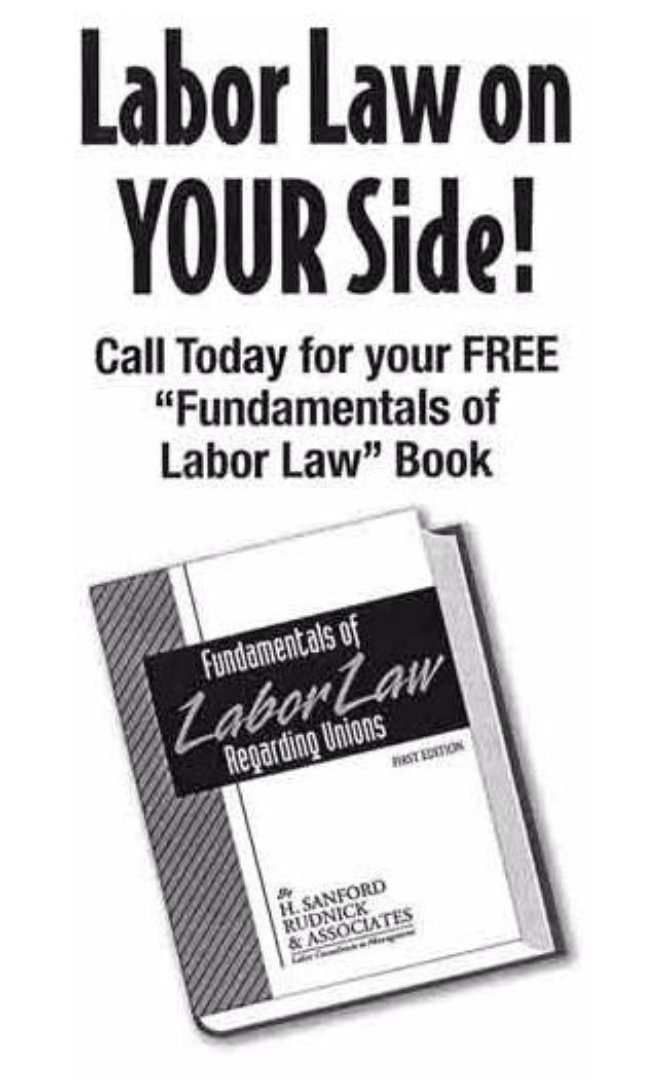
Fundamentals of Labor Law Regarding Unions
Written by H. Sanford Rudnick,JD "Fundamentals of Labor Law Regarding Unions" is a practical guide to the principles of labor law, union relations, and proceedings before the National Labor Relations Board (NLRB). Drawing on decades of experience representing employers, the book provides valuable insight into collective bargaining, union elections, labor disputes, and employer rights and responsibilities.
The book is included in the Harvard Law School Library collection and other law school libraries across the United States, reflecting its value as a respected educational resource for students, attorneys, and business professionals.
Whether you are an employer, executive, HR professional, or business owner seeking a better understanding of labor law, this book offers a practical foundation for navigating today's complex labor relations landscape.
To order your copy for $29.95, please call 1-800-326-3046.
We're Here to Help
Navigating labor and employment issues can be challenging, but you don't have to face them alone. Whether you're dealing with a union election, collective bargaining, an unfair labor practice, pension liability, or another labor or human resources matter, my team and I are here to provide practical guidance and experienced representation.
If you have questions or would like to discuss your situation, I invite you to contact me for a confidential consultation. We'll take the time to understand your concerns, explain your options, and help you determine the best path forward.
I look forward to speaking with you.
H. Sanford Rudnick, J.D.
Union & Labor Law Expert
1-800-326-3046
(925) 352-7900
sandy@rudnickpro.com
UNION & LABOR LAW ATTORNEY FOR EMPLOYERS
LAS VEGAS
H. Sanford Rudnick and Associates
300 South 4th Street, 6th Floor,
Las Vegas, NV 89101
NEW
YORK
1717 K St. NW S900J
Washington DC 20006
745 5th Ave. 8500
NY, NY 10151
CALIFORNIA
1990 N. California Blvd. S830,
Walnut Creek, Ca 94596
Direct Line - 925-256-0660
Cell Phone - 925-352-7900
H. Sandford (Sandy) Rudnick